Claude Fable 5.2: what's new in Anthropic's most powerful model?
Anthropic launched Claude Fable 5.2 on 9 November 2026: faster, cheaper and stronger at code, research and long agent tasks. What's new, and who is it worth it for?
Lees in het Nederlands →
A new AI model comes out pretty much every month. Even if you work with this stuff every day, it's hard to keep up. But this one is worth your time: on 9 November 2026, Anthropic launched Claude Fable 5.2, the new version of its most powerful model for heavy technical tasks.
I built this website myself together with Claude, by the way, so yes, I'm following this closely. In this article I list what's new, what it costs and who it's really interesting for. Right, let's get started.
What is Claude Fable 5.2?
Claude Fable 5.2 is Anthropic's newest model for the most demanding tasks: complex code, in-depth research and AI agents that keep working on their own for hours. It succeeds Claude Fable 5.1, which came out in September 2026.
Alongside Fable there's also Claude Mythos 5.2. It's the same underlying model, but with less strict safeguards around cybersecurity and biology. Mythos is only available to organisations that Anthropic admits through special verification programmes. So for most companies, Fable is the version that counts.
What's new in Claude Fable 5.2?
- Faster: up to 30% faster responses than Fable 5.1.
- Cheaper: $8 per million input tokens and $40 per million output tokens.
- More efficient: on the default setting (Medium effort) it handles difficult tasks with fewer tokens than Fable 5.1.
- Clearer: testers notice that it communicates more clearly than previous versions.
- Fast mode: an optional mode that responds up to 2.5 times faster, at a higher price.
- Fewer unjustified blocks: the safeguards around cybersecurity and biology are as strong as in Fable 5.1, but block things for no good reason less often.
How good is it really?
According to Anthropic's own figures, Fable 5.2 takes a big step forward, both compared with the previous version and with Claude Opus 5.5, the model Anthropic recommends for everyday work. A few results:
- FrontierCode 2.0 (would the maintainers of open-source projects accept the code?): 49.1%, compared with 32.4% for Fable 5.1 and 45.5% for Opus 5.5.
- Humanity’s Last Exam (with tools): 74.2%, compared with 65.6% for Fable 5.1.
- Remote Labor Index (real freelance assignments): 41.3%, compared with 17.9% for Fable 5.1.
Admit it, those are hefty leaps. Do bear in mind, though, that these are the maker's own figures.
What can Claude Fable 5.2 do in practice?
To me, what Anthropic and the first testers have already done with it is more interesting than the benchmarks:
- A team of AI agents migrated a critical production service at Anthropic from Python to Rust. That service now starts about 26 times faster.
- Starting from an empty folder, Fable 5.2 built a working prototype of an operating system in eight days, by directing more than 1,000 sub-agents.
- A team of 1,000 Fable agents formalised the proof of Fermat's Last Theorem in 30 hours.
- It solved two open problems in theoretical physics, to do with black holes.
- At Oracle, it wrote SQL queries for financial calculations that were correct, where two other models gave amounts that were 5 to 8 times too high.
What strikes me most: several testers say the model is more honest about what it does not know. Better “I don't know” than a convincing wrong answer. If you use AI in a business, that might just be the most important improvement of all.
What does Claude Fable 5.2 cost?
- Input: $8 per million tokens
- Output: $40 per million tokens
- Cache reads: $0.20 per million tokens
- Batch API: 50% discount on input and output
- Fast mode: $16 per million input tokens and $80 per million output tokens
For comparison: Claude Opus 5.5 costs $4 / $20 and Claude Sonnet 5.5 $2 / $10 per million tokens. So Fable is clearly the premium model. It can handle 1 million tokens of context and produce up to 128,000 tokens in a single response.
Who is Claude Fable 5.2 interesting for?
Anthropic itself is remarkably honest about it: for most tasks you're best off starting with Claude Opus 5.5, and only switching to Fable for the heaviest work. I'd sum it up like this:
- Yes: large software projects and migrations, in-depth research, agents that need to work on their own for hours, and analyses all the way through to a finished document, spreadsheet or presentation.
- Not needed: emails, summaries, chatbots and most everyday work. A smaller model is faster and cheaper for that.
Good to know: Fable 5.2 can also work as an “advisor”. A smaller model then does most of the work and only calls in Fable for the tricky bits. That keeps your costs nicely under control.
What should you watch out for?
- Data: Fable 5.2 requires Anthropic to retain your data for 30 days for safety monitoring. It isn't available under zero data retention unless Anthropic explicitly allows it. For sensitive business data, that's an important point.
- Cybersecurity: Fable's safeguards block most cybersecurity tasks. For those, there's Mythos 5.2, via Anthropic's Cyber Verification Program.
- Availability: Fable 5.2 works in the Claude apps on paid plans, via the API (model ID claude-fable-5-2) and via Amazon Web Services, Google Cloud and Microsoft.
My take?
To me, Fable 5.2 feels less like “yet another new model” and more like a shift. We're moving from an AI you ask questions to an AI you hand a complete assignment, and that can keep working on it independently for days. The lower price and the speed gains also make that a lot more accessible.
Still, I wouldn't advise any company to go all-in on Fable right now. For most everyday work a smaller model is enough, and it's faster and cheaper. Fable is the heavy machinery: you bring it out for the jobs where the other models get stuck. I'm going to test it on a few of my own projects over the coming weeks, and you'll be able to read more about that here soon.
Frequently asked questions about Claude Fable 5.2
When did Claude Fable 5.2 come out?
Anthropic launched Claude Fable 5.2 on 9 November 2026.
What's the difference between Claude Fable 5.2 and Claude Mythos 5.2?
It's the same model. Fable has stricter safeguards around cybersecurity and biology and is available to everyone; Mythos is only available to organisations that Anthropic verifies.
Is Claude Fable 5.2 better than Claude Opus 5.5?
On almost all of Anthropic's benchmarks, yes, but it's also twice as expensive. For everyday work, Anthropic itself recommends Opus 5.5.
How do you use Claude Fable 5.2 via the API?
With the model ID claude-fable-5-2 on the Claude Platform, or via Amazon Bedrock, Google Cloud and Microsoft Foundry.
Sources
More from this zone

Anthropic goes public: what changes for your business?
Anthropic, the maker of Claude, listed on the Nasdaq on 19 November 2026 in the largest IPO ever. What does that mean for businesses using Claude: prices, data and continuity?
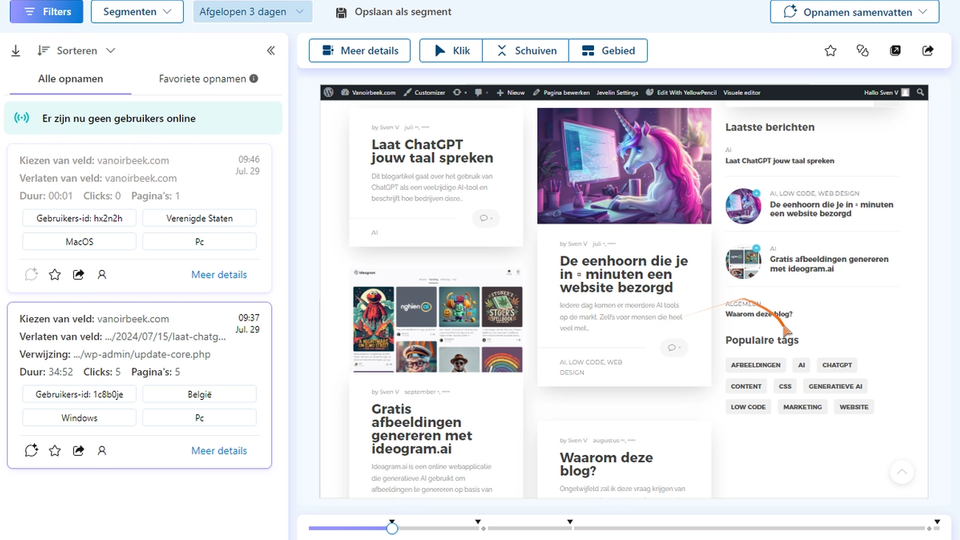
Discover the invisible: optimise your website with Microsoft Clarity
Everyone has heard of Google Analytics at some point. It shows you who visits your website, from which region, which pages are popular, which aren’t and much more. It’s a great tool, but it can also be complex.